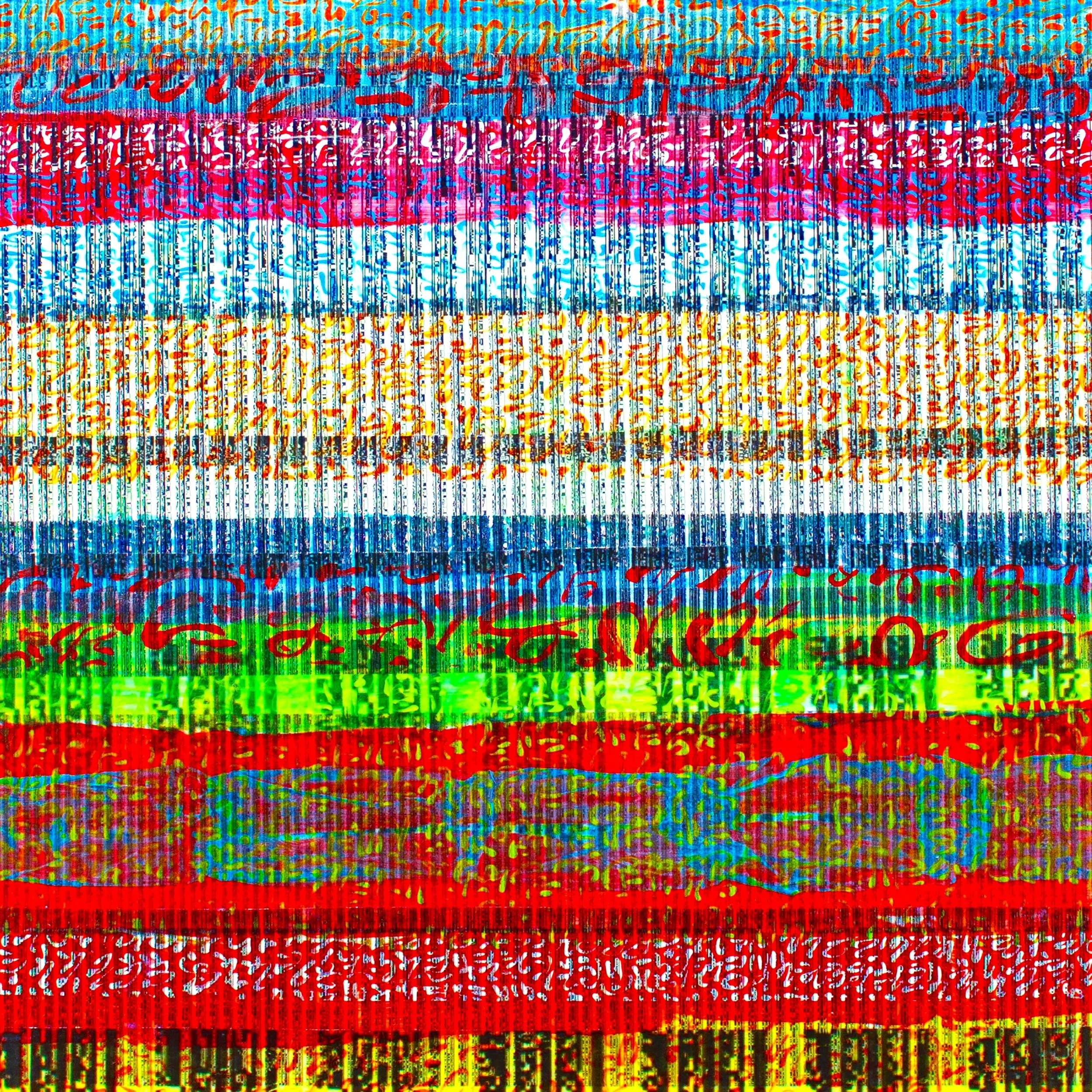
Online Gallery Creighton Michael's work explores the various facets of drawing from its material composition, its physical articulation associated with different processes and its involvement with emerging patterns to its relationships with other marking systems such as musical notation and calligraphy. The results of these investigations exist in two, three and four dimensional formats. For him drawing is always primary not preliminary.
 |
| Works on Paper |
| FOTODIGAGRAM © is a current category of digital drawings containing works that are either created by layers of process and marking history or by direct drawing activity and marking manipulation. Video stills, 35mm negatives, sculpture, digital images and solar plate acetates are some of the unconventional drawing tools employed in developing this hybrid graphic work. Imagery in each of the series is process driven and ranges from documentation to pictorial. Existing as digital files, FOTODIGAGRAMS are produced as intaglio or digital carbon pigment prints. TAPESTRY is an example of an early FOTODIGAGRAM, laminating marking history with various episodes of process, while ORCHID and LACE capture the visual residue of a direct drawing method. An unexpected by-product of this direct drawing approach is a more believable pictorial space reminiscent of seemingly familiar places or memories, while continuing a conversation on the nature of abstraction. |
|
 |
| Painting |
The influence of natural structure in general and its relationship to drawing in particular form the basis for his return to painting in the early 1990’s. His first series, DUST, is a response to the incremental structure and ever-changing pattern of duckweed, a floating aquatic plant. The emphasis on a mark and its evolution into pattern becomes his approach to painting. In the HAIKU series, his graphic language is expanded by mold that is grown to intersperse with his painted marks on canvas. NOTATION, MESH and VESTIGE reference both Chinese brush painting and calligraphy by continuing to compare the world that is seen with the world that is felt. The nine paintings of NOTATION contain a developed marking vocabulary from which all later paintings are derived.
|
|
 |
| Sculpture |
| Since 1985 drawing activity was employed to create sculpture whose intimacy as well as immediacy with the viewer was parallel to that of drawing. His intuitive process went from drawing with an electric saw on sheets of plywood to “drawing in space” by orchestrating steel fabricators in the skeletal construction of pieces like TEAHOUSE and NARRATIVE. To him “Drawing is primary, not preliminary.” By 1996 this exploration ceased and he returned to the development of his painting. In 1998 the concept of synchronous viewing, which occurs in late reed pen drawings of Vincent van Gogh, was the basis for a new series of ink drawings titled RHAPSODY. This notion, that a mark is seen simultaneously as an individual unit and collectively as pattern, became the genesis for a new body of three-dimensional work. Under the category of DIMENSIONAL DRAWINGS, many series and installation works have emerged. |
|
|